
Dr. Phil Finemore is TBR’s first repeat featured blogger! Dr. Phil is the owner of Workfitme Mobile PT. Thank you Phil for sharing your expertise and coaching cues. Read on for Phil’s very helpful cues to engage the glute med. And be sure to check out his podcast Strength For A Purpose.
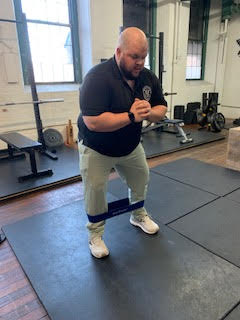
The Monster Walk. The banded side step. Whatever it may be called it is a go to warm up exercise in strength training programs at just about every gym I have worked in or worked out at. And for good reason. It’s a great, functional exercise that improves the gluteus medius activation and strength/endurance of the foot on the ground. Which is when our gluteus medius (glut med) is supposed to work best for us in day to day life.
However, way too often I see this exercise being performed with inconsistent form and without progression. So I wanted to share some of the inconsistencies I look for and make sure my clients are doing this exercise correctly. We want to ensure they are getting the most out of the movement without feeding into compensations that got the glut med weak to begin with.
First, we have to understand the mechanics of the movement, specifically if the front or trailing glut med is doing (or should be doing) most of the work. If we know that the glut med on the trail leg activates the most when this exercise is done with proper form, it’ll help us cue this exercise better.
Second, now that we know our trail leg is the focus, we need to avoid compensations that would shut that trail leg down. Leaning towards the working side in any closed chain glut med exercise will inhibit that muscle. That means if the client is taking such a large step they have to lean toward that trail leg, they aren’t getting the most out of that exercise. We have to make sure we cue people to keep their upper body quiet to keep the trail leg glut med as active as possible.
Third, we can use the principle of time under tension to take the exercise up another notch. By making sure the client isn’t leaning one way or another while simultaneously keeping tension on the resistance band the entire time, they will get the best glut med workout they have probably ever had.
Finally, even though this is a warm up exercise for most in the strength training world, it is one we should still progress. If we are working our larger muscle groups with secondary movements that overlap and compliment our primary movements, (all of which is done with progression) we should treat these smaller muscle groups the same. Especially the glut med. Most people, no matter how active, are weak here. So if we always keep that band at the knees and never progress it (once good form is established) we are holding people back. The progression is quite easy, just move the band closer to the ankles. The lower it is the harder it will be.
I don’t share all of this to say people are doing clients a disservice or not helping them to the best of their ability. I think this banded side step motion has a lot of variation and the understanding of what we are trying to accomplish has varied enough that it develops inconsistencies in how we approach applying it in programming. I hope this helps gives a better all encompassing view of the exercise and how we can maximize it for our clients to be successful on their health and wellness journeys!

 The Break Room